
Conversion is not a property of a feature. It is a property of the uncertainty a shopper was carrying when they arrived, and whether the feature removed it.
That reframing decides whether digital try-on is worth building for your store, and it explains why published conversion figures for it vary so widely that they are close to useless as a planning input. Two brands can deploy comparable features and get opposite results, because their customers were hesitating over different things.
Two uncertainties, and only one of them is visual
A shopper hesitating over an apparel purchase is usually uncertain about one of two things.
The first is what it looks like. How does this actually read on a body, is the proportion what I think it is, does it work with the way I dress. This is a visual question and imagery addresses it directly.
The second is whether it will fit. Is my usual size right here, will the shoulders work for me, is this cut for a body like mine. This is a physical question and no image answers it, however convincing the image is.
Whichever of the two dominates in your category determines whether a visual feature can move anything. That is knowable in advance, and it is a better predictor than any benchmark.
Customer service records are the fastest way to establish which one you have. The questions arriving before purchase, rather than the complaints arriving after, describe the uncertainty that is currently costing sales. A week of those, sorted into visual and fit, gives a more grounded answer than a strategy discussion.
What each uncertainty responds to
| Uncertainty | What resolves it | What does not |
|---|---|---|
| How it looks on a body | On-model imagery, multiple angles, varied bodies | Size charts |
| How it looks styled | Full-look imagery, context shots | Product-only imagery |
| Whether the size is right | Measurements, fit guidance, reviews from similar bodies | Any image |
| How the fabric behaves in wear | A physical garment | Any image |
| What color it really is | A physical reference, or a customer's tolerance for variance | Screen rendering |
The third and fourth rows are where returns concentrate in apparel, and neither is touched by a try-on feature. A brand expecting a visual feature to reduce returns has mapped it to the wrong row.
The first two rows are real and worth addressing. They just have to be the rows your customers are actually stuck on.
Which categories are visual-uncertainty dominated
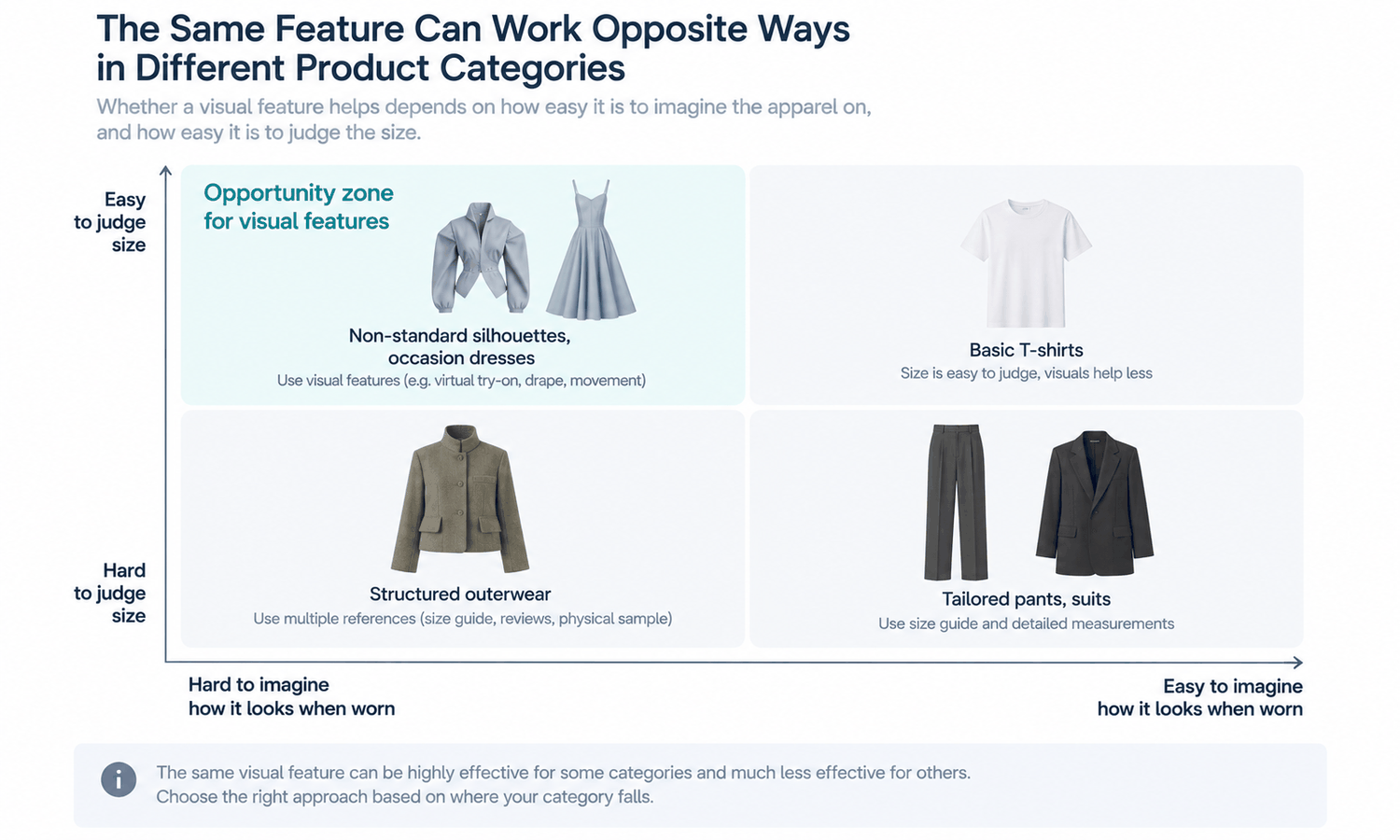
Some products are hard to picture and easy to size. Those are where a visual feature has the most room to work.
Unusual silhouettes qualify — anything a shopper cannot immediately imagine on a body from a flat product shot. So do styling-dependent pieces, where the item makes sense only in combination and a product-only image undersells it. Occasion pieces, where the shopper is imagining a specific context, sit in the same group.
The opposite case is a category where sizing is the whole question. Fitted trousers, tailoring, anything with a narrow tolerance — the shopper knows exactly what it looks like and does not know whether it will fit. A visual feature is answering a question they had already answered.
Sort your own range this way before evaluating anything. It takes an afternoon and produces a better prediction than a vendor case study from a different catalog.
The sort also tends to be uncomfortable, which is a sign it is working. Most ranges turn out to be dominated by the fit column, and the visual opportunity concentrates in a smaller group than anyone expected — which is still a real opportunity, just a narrower and more targetable one than a catalog-wide rollout.
What a shopper-facing feature actually asks of a brand
The customer-facing experience is the visible part and rarely the expensive part.
Behind it sits an asset requirement — imagery for every product the feature covers, produced to a consistent standard, kept current as the range turns over. A feature that works on forty percent of your catalog creates an inconsistent experience that can perform worse than no feature, because shoppers learn to distrust it. Coverage at catalog scale is what the multi-task mode and a shared model library are for — the constraint is keeping it current as the range turns over, not producing it once.
There is also a maintenance cadence. Ranges change, and a try-on experience showing last season's coverage degrades quietly. Someone has to own currency, and that ownership is a recurring commitment rather than a launch task.
Budget the second year before approving the first. Features of this kind are frequently funded as a project and then maintained out of nobody's budget, which produces the pattern where coverage is excellent at launch and patchy within two seasons.
Whatever produces the underlying assets, the requirement is the same: consistent on-model imagery, at catalog scale, kept current. The AI Virtual Try-On module in Lightchain AI (apparel AI) produces that imagery from existing product photographs — see AI Virtual Try-On, and Scale E-commerce for how coverage is maintained across a catalog.
How to tell if it converts on your store
The only figure that matters is yours, and getting it is a design problem rather than an analytics problem.
Split by product rather than by visitor where you can, since a visitor-level split leaks: shoppers browse across products and the experience becomes inconsistent. Choose a set of products with the feature and a comparable set without it, matched on price, category and traffic.
Run it long enough to cover a full purchase cycle including returns, because a conversion lift that arrives with a returns increase is not a lift. Measure both, and measure them on the same cohort.
Read the result by category rather than in aggregate. A blended figure across a mixed range will show a small effect that is actually a large effect in one group and nothing in another, and the split is the finding.
Decide in advance what result would lead you to stop. A test with no failure condition tends to be interpreted generously afterward, particularly by whoever proposed it, and the interpretation happens at the moment the numbers are least clear.
Why borrowed conversion figures mislead
Published numbers for this category come from specific catalogs, specific customers, and specific implementations, and none of those transfer.
A figure from a brand selling occasion dresses tells you about visual uncertainty in that category. A figure from a brand selling technical outerwear may reflect a completely different mix. Neither predicts your result, and the range between published claims is wide enough that a brand can find support for any position it already holds.
Treat external figures as evidence that the effect exists somewhere rather than as an estimate of your own. The only defensible number is one from your own store, on your own products, measured against a control. Quoting someone else's figure in an internal business case also creates a target you will later be measured against, which is an avoidable way to make a working project look like a failure.
What the feature cannot do
Worth stating plainly because the commercial pressure to overstate is strongest here.
The output is a visual asset. It does not predict fit, determine sizing, model how a fabric behaves in motion, or forecast returns. Those come from measurements, a graded pattern, a physical sample and your own data.
A shopper who cannot tell whether a size will fit is not helped by a better picture, and returns driven by fit will not move because the imagery improved. If your returns analysis points at sizing, the intervention is sizing guidance, not visualization — and conflating the two produces a project that is judged against a target it was never able to reach.
Questions apparel teams ask
Does digital try-on increase conversion? It can, where the shopper's hesitation was visual. Where the hesitation is about fit, a better image addresses a question they were not asking, and the effect is small or absent.
Which products should we launch it on? Ones that are hard to picture and easy to size — unusual silhouettes, styling-dependent pieces, occasion items. Sorting your range this way predicts results better than any external figure.
Can we use published conversion numbers to build a case? Only to establish that an effect exists somewhere. They come from other catalogs and other customers, and the published range is wide enough to support almost any position.
How long should a test run? Long enough to include returns for the same cohort, since a conversion lift accompanied by a returns rise is not a gain. Measure both together.
Will it reduce returns? Not where returns are driven by fit, which is the dominant cause in most apparel categories. Sizing guidance addresses that; imagery does not.
What if we can only cover part of the catalog? Consider whether partial coverage is worse than none, since an inconsistent experience teaches shoppers not to rely on it. Full coverage of a defined category usually beats scattered coverage across the range.
What decides the answer for your store
Not the feature and not the vendor. Which of two uncertainties your customers arrive with, and whether the one you can address is the one blocking them. Sort your range into hard-to-picture and hard-to-size, deploy where the first dominates, run a product-level test with a matched control, and read the outcome by category with returns included in the same window. If your own numbers say it works on occasion pieces and does nothing on tailoring, both halves of that sentence are useful and neither would have come from someone else's case study.
Sort your range by which uncertainty dominates.
**Go through your top categories and mark each one as hard to picture or hard to size. Deploy on the first group, hold the second as a control, and measure conversion and returns on the same cohort over a full cycle. That single exercise answers the question for your catalog, which is the only place the answer is portable. → **AI virtual try-on
About the author
[RELACE — real person's name, role, relevant experience, LinkedIn URL. No team byline.]